
AI Is Not Coming for Humans. It Is Coming for Friction.
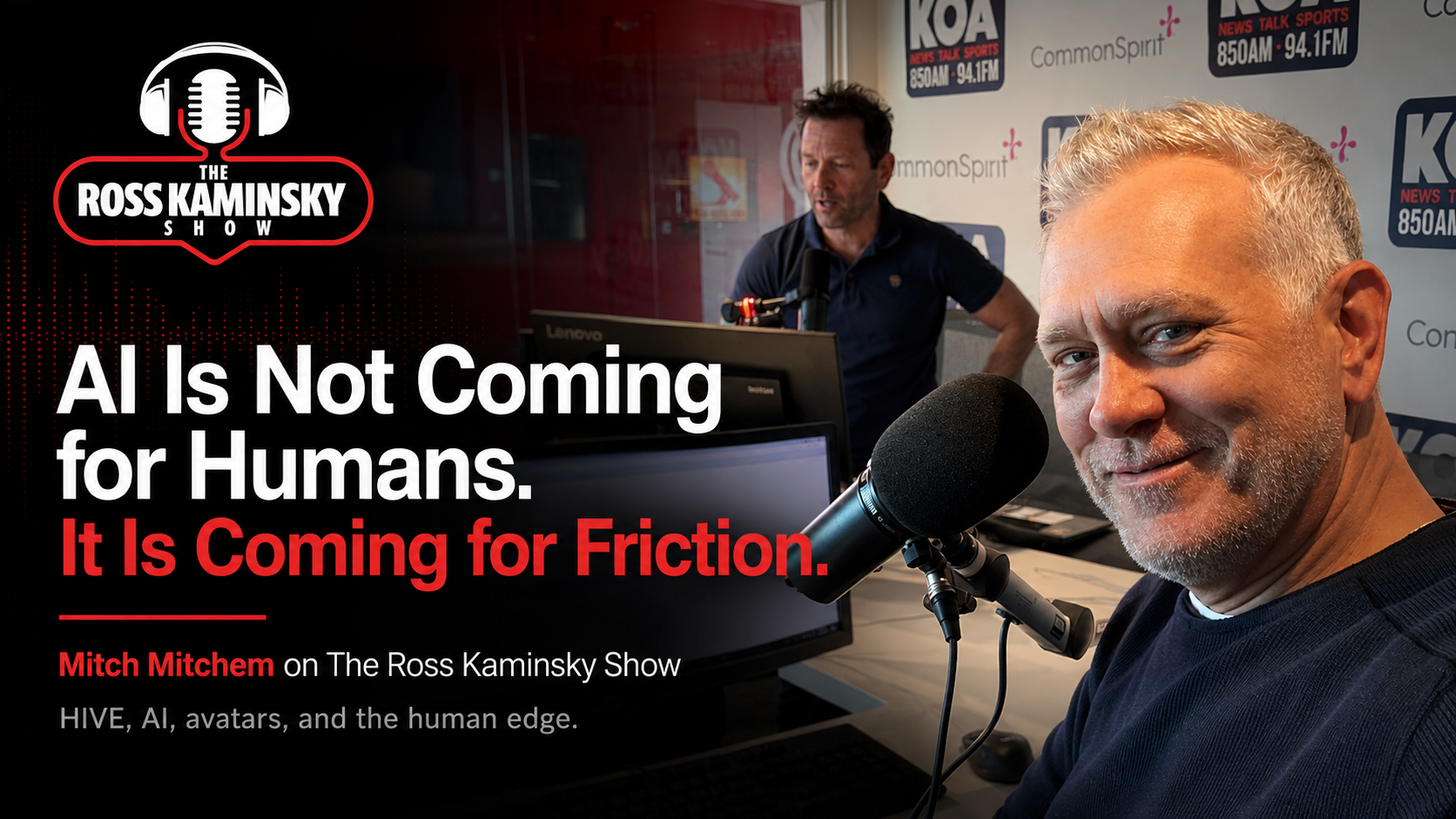
CEO Mitch Mitchem was on The Ross Kaminsky Show today talking about AI, jobs, avatars, my company HIVE, and my book, F' Your Friction.
You can listen to the full interview here:
The conversation reminded me of something I believe more strongly every day, most people are still asking the wrong question. They keep asking, “Will AI replace humans?” That is the fear question. The better question is, “What parts of our work, our companies, our lives, and our systems are filled with unnecessary friction that should have been eliminated years ago?”
Because that is where AI gets interesting. Not as a robot boss. Not as a replacement for wisdom. Not as some magical cheap button companies press to fire everyone and print money.
That fantasy is already starting to break down. Businesses are learning, in real time, that AI is not free. It is not always cheap. It is not automatically effective. And it is not useful when the human on the other side has no goal, no judgment, no communication skill, and no idea what they are actually trying to accomplish.
AI does not fix unclear humans. It amplifies them. That is the part almost everyone missed.
If you know how to think, communicate, decide, discern, question, challenge, and direct, AI can make you dramatically more effective. If you do not, it just gives you faster confusion. This is why I have always said the future is not AI versus humans. The future is humans who know how to use AI versus humans who refuse to evolve.
Businesses are learning the same lesson.
You cannot simply remove the human layer and expect the machine to inherit wisdom. AI can process data. It can summarize. It can generate. It can search. It can accelerate. But it does not know your customers the way your best people do. It does not carry the hard-earned judgment of a leader who has been through crisis, pressure, failure, and consequence.
“Raw knowledge is now basically free.
Wisdom is more valuable than ever.
That is the distinction.”
I can ask AI how to drill a natural gas well. I can learn the vocabulary, the steps, the equipment, the risks, and the theory. But that does not mean I should walk onto a field site and start drilling. I would blow myself up.
The people who actually know how to do the work have wisdom. AI gives access to knowledge. Humans give it meaning. That is the hybrid world we are entering. And that brings me to friction. Friction is the unnecessary obstacle between you and the outcome you want. It is the chatbot that blocks you from a human. It is the smart TV that takes 30 minutes to set up because the company wants your data. It is the insurance claim that gets denied because the system is designed to exhaust you. It is the app you have to download just to valet your car. It is the form, the portal, the login, the delay, the hold music, the corporate maze, the fake convenience, the broken process, and the quiet theft of your time.
“We have built a culture that profits from friction.
And I wrote F*CK YOUR FRICTION because I am done pretending that is normal.
The book is not just a rant. It is a field manual.”
It is about seeing the systems that slow you down, naming them, breaking them, and using tools like AI to get your time, money, focus, and momentum back. Because AI should not be used to make human life more complicated.
It should be used to remove the garbage that gets in the way of humans doing what humans do best.
Create.
Lead.
Decide.
Love.
Build.
Connect.
Think.
Move.
That is also why we built My HIVE AI.
The avatar work we are doing is not about deepfakes. It is not about replacing people. It is not about creating some creepy digital imitation of a human being. It is about lived experience. It is about building avatars that can carry story, memory, wisdom, tone, perspective, and guidance in a way that feels useful and human.
I built one based on my grandfather. He died when I was seven. He did not say much when he was alive, but when he did, it mattered. Now I can interact with an avatar built from his story, his lived experience, and the lessons I remember from him. It is not him. I would never claim that. But it is a meaningful way to engage with the wisdom, memory, and presence of someone who shaped me.
That is where AI becomes powerful.
Not when it pretends to be human.
When it helps us preserve, access, and apply the human things that matter.
Enjoy the interview.
