What we have learned at HIVE about building people who can actually perform in a workplace being rewritten by AI
Before I give you the five things, here is a true story. Our client gave me permission to share it because what happened to them has become one of the most important lessons I can give any organization thinking about workforce development or AI training right now.
In 2024, HIVE was approached by a client in the tourism space and they needed help on their sales team. The initial request sounded straightforward, they had a sales team that was struggling to leverage AI effectively, and leadership believed AI could help them create stronger outreach, build better presentations, become more efficient and ultimately close more business. And their CEO at the time, along with the SVP of sales, felt the problem was an underutilization of the AI tools the team had access to. So, they wanted us to develop the team around AI, and on the surface, that seemed like exactly the engagement we should build.
Then we spent the first day with the team in our discovery.
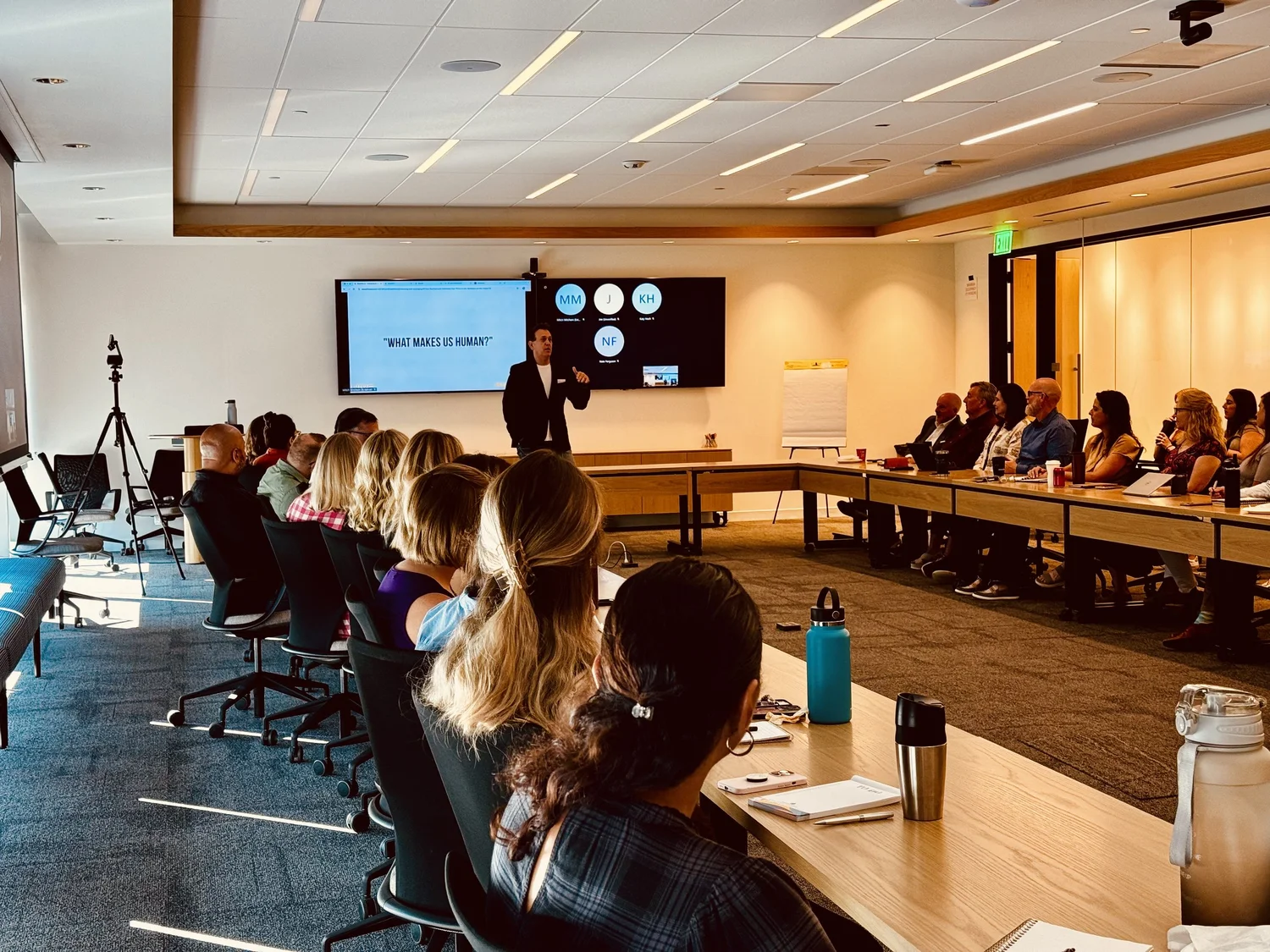
Now, I should let you know, our brand of discovery is different. It is fun, engaging, and designed to open the room up so people actually talk. Because of my background at Second City and as a learning and development professional for 20+ years, we use improv, experiential learning, real-world exercises, and live interaction to stress-test the environment, understand how the team really works, and surface the things that rarely show up in a survey. We get to know the people, the dynamics, the friction, and the reality underneath the stated challenge. That is how we get past the symptom and to the heart of the issue.
It became obvious very quickly that they did not primarily have an AI problem. They had a sales development problem, an accountability problem and a presentation problem. There were also deeper leadership-development needs sitting above all of it. AI could absolutely help them research prospects, scale outreach, prepare for meetings, develop sales materials and create better slide decks, but all the AI in the world was not going to fix the fact that some of the foundational human capabilities required to actually win the business had been underdeveloped.
In fact, putting powerful AI into that environment without solving those problems first could have made things worse. AI would simply have amplified what already existed. Weak sales messaging could be generated faster. Mediocre presentations could be created more efficiently. A lack of accountability could hide behind more activity. People could produce a tremendous amount of work without necessarily becoming better at selling.
The CEO was not wrong about AI. He was caught in the same AI hype cycle that has affected a lot of very smart leaders. He could see that the technology was going to change the way his people worked, but he had been led to believe that AI training itself was the solution. What he was really asking for was workforce development, even though he did not know to call it that.
That mattered because we at HIVE were a learning and workforce-development company long before AI entered the picture. My own background includes learning and development, along with decades of leadership, entrepreneurship, presentation, facilitation and performance. And when my wife and I founded HIVE, we combined all that with her expertise in critical systems analysis to build what we have today. Thus, we knew how to look underneath the requested training and ask a different question: What does this workforce actually need to become capable of doing?
The answer completely changed the engagement.
What started as a relatively simple AI initiative became a two-year journey involving AI skills, leadership development, accountability, sales demonstration skills, presentation skills, communication, coaching, team development and other capabilities that had to work together. The organization did not just learn how to use AI in a way most people dream of. The people became better at the work around the AI and became better humans. (their words not ours.)
Today, that team has become one of their clients’ go-to groups when sales success matters. That did not happen because HIVE gave them better prompts. It happened because we answered the questions hiding underneath the question they originally asked.
And that leads to the first thing you need to know.
1. The Training You Are Asking For May Not Be the ONLY Development Your Workforce Needs
One of the most expensive mistakes an organization can make is assuming the requested training is automatically the correct training.
Someone says, "We need AI training." Someone else says, "Our managers need leadership training." Sales asks for presentation skills. HR sees an accountability problem. A department head wants team building. These may all be legitimate requests, but they are symptoms until you understand what is actually happening in the work.
Good workforce development begins with diagnosis.
If employees are not adopting AI, why not? Do they lack technical knowledge, or do they not understand their workflows well enough to recognize where AI belongs? Are the goals clear and meaningful enough? Is anyone holding them accountable for actually changing how they work? If managers are struggling, do they need another leadership model, or have expectations never been clearly defined? If sales presentations are weak, is the problem PowerPoint, storytelling, confidence, product knowledge, listening, business acumen, or the ability to lead a customer toward a decision?
Those are completely different development problems.
This is why we believe workforce development has to begin with capability, not content. Stop asking first what class people should take. Ask what your people need to be able to do differently when the development is finished. And also ask what is the goal at the end of it all?
Clients may come to HIVE asking for AI training, but our job is not to assume AI is the answer or to redirect them into a menu of other programs. Our job is to discover the capability standing between the organization and the result it wants. Sometimes that is AI. Sometimes it is leadership, accountability, presentation skills, team dynamics, communication or a combination of several things working together. We are not looking for more training to sell. We are looking for the real performance problem to solve.
There is also language here that matters. Training is exposure to wisdom or a skill. Learning is understanding it then applying the lesson immediately. Development is building capability over time. Enablement means giving people the knowledge, tools, systems, confidence and support to use that capability in the real world. Implementation means the behavior actually appears in the work and produces an outcome. And behavior change only comes over time.
Those words are not interchangeable.
An organization can train thousands of people while implementing almost nothing.
2. AI Is Not a Separate Workforce Skill Anymore
The second thing leaders need to understand is that the separation between "AI skills" and "human skills" is becoming increasingly artificial.
AI is becoming part of the work itself.
That means an employee who uses AI effectively still needs judgment and they need communication skills to provide context and direction. That same person needs critical thinking to evaluate the output while applying enough expertise to recognize when something is wrong. They need accountability for the decisions they ultimately make but at the same time to cultivate curiosity to explore better approaches and the confidence to challenge what the machine gives them.
Managers need even more.
A leader now has to understand how to manage people who are working with AI so they can determine what can be delegated, what must remain human, how AI-assisted work should be evaluated and who owns the result. They need to encourage experimentation without creating chaos. They need to build trust while also creating standards and accountability.
Then there are presentation skills, which I believe will become even more important as AI grows.
How many bad presentations have you sat in, or worse, how many have your prospects sat in from your own team? AI can research the customer, can analyze information, organize an argument and can even write the proposal then build the deck. Eventually, however, somebody still has to sit across from another human being and make the idea matter. Somebody has to read the room, listen, respond to resistance, explain something clearly, establish credibility and move people toward a decision. That's human skill.
A beautiful AI-generated presentation delivered badly is still a bad presentation.
This is why we do not look at AI enablement, leadership, communication, presentation skills, team dynamics and accountability as unrelated categories anymore. They are increasingly parts of the same performance system.
The real goal is not to create a workforce that is good at AI.
The goal is to create a workforce that is amplified because of AI, while becoming even stronger at the human capabilities the technology cannot replace.
3. AI Amplifies the Workforce You Already Have
This may be the most uncomfortable lesson of the five.
AI is an amplifier.
That is fantastic when the thing being amplified is expertise, creativity, curiosity, good judgment, strong communication and a well-designed process. It is considerably less exciting when AI begins amplifying confusion, bad leadership, weak accountability or poor decision-making.
Our tourism sales client taught us this in real time. Giving that team AI without strengthening sales skills and presentation capability first would not have magically transformed them into elite salespeople. The technology could have helped them do more, but doing more is not the same thing as performing better.
A leader who cannot clearly define an outcome will struggle to direct AI toward one, an employee who does not understand the business will have difficulty judging whether an AI-generated recommendation actually makes sense, and a team with unclear roles can become even more confused once agents and automated workflows begin performing pieces of the work. Add weak accountability to that system and AI can help produce mountains of activity without anyone truly owning the result.
Before you automate something, amplify something or hand it to an AI agent, you need to understand the human system surrounding it and whether that system is strong enough to benefit from more speed, more output and more scale.
Ask yourself a difficult question: If AI makes this person, process or team dramatically faster tomorrow, are we certain we want more of what they are currently producing? Sometimes the answer will be yes, and sometimes that question alone will save you a tremendous amount of money.
4. Workforce Development Has to Change Behavior, Not Just Transfer Information
This is where my learning-and-development background becomes especially important, because organizations have been struggling with this problem long before AI arrived.
Knowing something is not the same thing as doing it.
Have you ever listened to a lesson and thought, “I know that already. That’s not new,” only to look in the mirror and realize you are not actually demonstrating the behavior at all? That is the difference between knowing something and being able to live it consistently. Someone can understand everything taught in a leadership workshop and still avoid the difficult conversation on Monday morning, can learn a presentation framework and abandon it the next time they are nervous in front of an executive, or can attend an incredible AI program, get excited about the technology and three weeks later be doing the job almost exactly the way they did before.
That is not necessarily a training failure. More often, it is a development-design failure.
At HIVE, we use four elements when we think about lasting behavior change: Catharsis, Expectation, Coaching and Practice.
Catharsis is the emotional moment when somebody understands why the change actually matters. Human beings rarely transform because they received another PDF. Something has to connect the new behavior to an outcome they care about. They have to feel the difference between where they are and where they could be.
Then comes expectation. Leadership has to make it clear that the new capability is expected to appear in the work. If the organization says AI is important during a workshop but managers never ask about it again, employees hear the real message. If accountability is taught but leaders continue tolerating the old behavior, the old behavior wins.
Coaching is where people get help applying the skill when the situation becomes messy. This is incredibly important because the real world never behaves exactly like the training exercise. People need feedback, correction, reinforcement and sometimes permission to try again.
Finally, there is practice. People need repetitions. Leaders have to practice leadership. Presenters have to present. Salespeople have to rehearse. Teams have to work through decisions. Employees have to use AI inside actual workflows, evaluate the results and improve their approach.
This is how learning becomes capability.
If your workforce-development strategy ends when the workshop ends, you should not be surprised when the behavior eventually ends too.
5. Stop Building a Training Calendar and Start Building a Workforce Strategy
This is where I think the entire conversation is heading.
Most organizations have historically treated learning as a catalog. There is leadership training over here, compliance over there, presentation training somewhere else, perhaps a sales program, a team-building event and now a shiny new section labeled AI. That model makes less sense every year.
The better question for senior leaders, HR teams, talent leaders and learning professionals, tourism leaders, sports teams and everywhere in between is: What kind of workforce are we trying to build over the next two or three years?
What should your people be exceptionally good at? How should your managers lead? How should decisions get made? Where should accountability live? How should teams communicate? How should employees present ideas and influence others? What role should AI play in the work? What should remain deeply human? Which capabilities will matter more as automation increases rather than less?
Then build the development strategy around those answers.
Sometimes that means a keynote starts the process because people need the catharsis. Sometimes it means practical AI enablement. Sometimes leadership development has to happen before the larger workforce initiative can succeed. Sometimes presentation skills are the missing piece. Sometimes the organization needs coaching, teamwork, accountability, better communication or a combination of all of them.
That is exactly what happened with the client I told you about at the beginning.
They thought they were buying AI training. And they got that but they also received a stronger workforce because we knew what to look for. And there is a big difference.
AI has made workforce development more urgent, but it has also given organizations an incredible opportunity to rethink what development is supposed to accomplish. This is not about collecting courses or chasing the newest technology. It is about deliberately building people who can think, communicate, lead, present, collaborate, take accountability, adapt and use powerful technology to become dramatically better at the work.
That is what we have learned doing this work at HIVE.
The best workforce-development conversations often begin with a client telling us what training they think they need.
The real value begins when we figure out what is hiding underneath. Can you find that for your team? It’s the difference between wasting money and time, and Amplifying your team.
And if you need help today remember, HIVE is not an AI training company that also teaches human skills. HIVE is a workforce development company built for an age in which AI and human capability have become inseparable.
To book your workforce development assessment, email Diana@ahumanhive.com